Material and chemistry
Review solvent exposure, adsorption, autofluorescence, gas permeability, and bonding method.

Microfluidic chips
Compare PDMS, glass, COC, and PMMA microfluidic chips for research, assay development, droplet generation, cell culture, and custom prototyping.
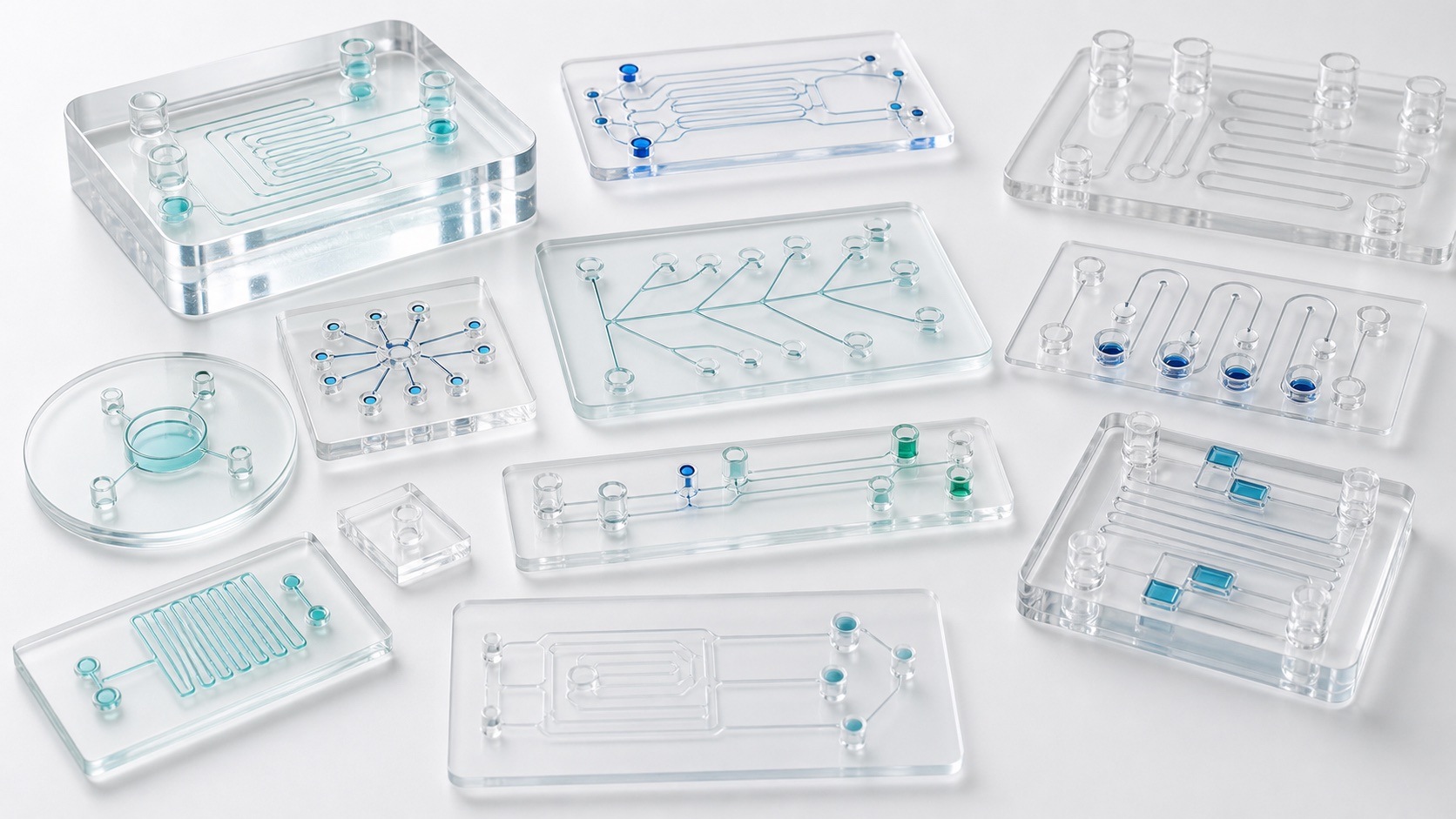
Selection answer
Choose a chip material around the fluid, optical method, channel geometry, required volume, and development stage. PDMS is practical for early soft-lithography work; glass supports optical and solvent-intensive workflows; COC and PMMA can suit cartridge-oriented development when the manufacturing path is considered early.
Technical content reviewed by MicroCD Labs · Updated July 28, 2026. Confirm final selection against the written quote, applicable source documentation, and the complete research system.
Before requesting a quote
MicroCD Labs reviews compatibility, documentation, final pricing, availability, and lead time before payment.
Review solvent exposure, adsorption, autofluorescence, gas permeability, and bonding method.
Define channel dimensions, ports, dead volume, pressure, and compatible tubing or fittings.
Match the chip process to the current experiment and the likely scale-up route.
Research-use catalog
Open an item for variants, specifications, source and production-route review, documentation, and quote status.
Chip materials
Source and production route confirmed by quote.
Soft-lithography style PDMS chips for early experiments, assay development, and proof-of-concept flow work.
Chip materials
Source and production route confirmed by quote.
Glass chips for optical clarity, solvent compatibility, and higher-performance analytical workflows.
Chip materials
Source and production route confirmed by quote.
Cyclic olefin copolymer chips for scalable diagnostic, optical, and cartridge-style development.
Chip materials
Source and production route confirmed by quote.
PMMA chips for clear, economical prototyping and application-specific microchannel layouts.
Chip functions
Source and production route confirmed by quote.
Passive mixer chip options for reagent blending, concentration gradients, and laminar-flow experiments.
Chip functions
Source and production route confirmed by quote.
Flow-focusing and T-junction chip options for emulsions, droplets, and encapsulation studies.
Cell and tissue chips
Source and production route confirmed by quote.
Research-use organ-on-chip formats for cell culture, perfusion, barrier, and tissue-model studies.
Cell and tissue chips
Source and production route confirmed by quote.
Microfluidic culture devices for media perfusion, small-volume assays, and live-cell imaging workflows.
Custom fabrication
Source and production route confirmed by quote.
Custom design-to-device support for channel layouts, material selection, ports, bonding, and small runs.
Custom fabrication
Source and production route confirmed by quote.
Prototype planning and sourcing for early microfluidic experiments, holders, tubing, and flow hardware.
Technical review
Share the fluid, target flow or pressure, interface sizes, and intended research workflow. We can help build a compatible shortlist.