Disc architecture
Channel geometry, chamber volumes, capillary valves, siphons, waste handling, balance, and spin protocol.

Centrifugal microfluidic platform
Platform concept — in developmentAn origami-inspired lab-on-disc concept exploring how staged fluid handling, centrifugal actuation, and compact readout could support diagnostic-assay research in resource-constrained settings.
Early-stage research concept only. InvertaDx is not a finished or commercially available product and has no established analytical, clinical, regulatory, or manufacturing performance.
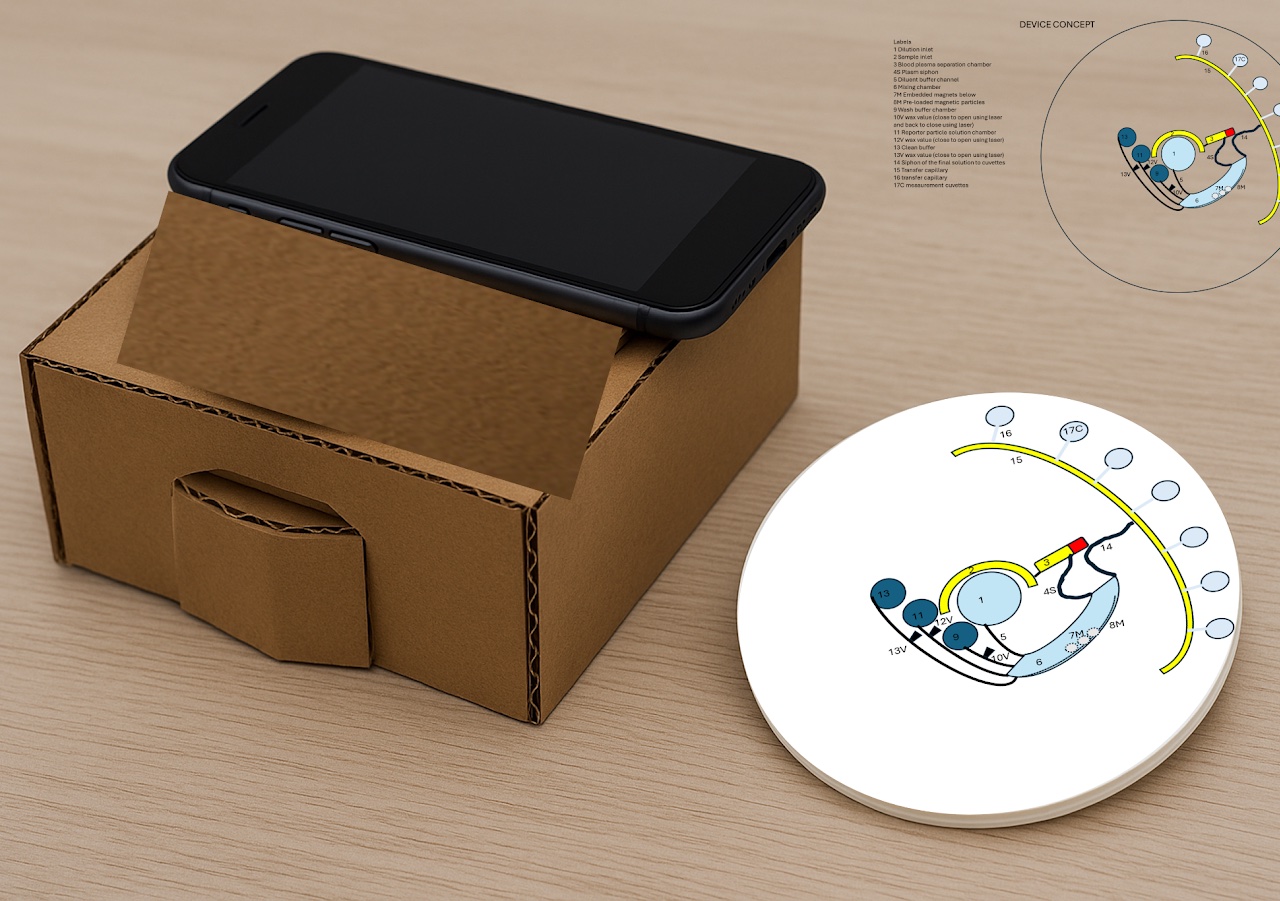
Development question
The concept brings sample entry, staged reagent handling, separation, washing, mixing, waste capture, and measurement regions into one centrifugal architecture.
The “origami” direction refers to folding or layered construction approaches that may help organize channels and chambers while keeping early prototypes accessible. Final materials, fabrication method, assay chemistry, and readout remain to be defined and tested.
Proposed assay path
The source concept drawing suggests the following functional sequence. It is a development hypothesis, not a verified operating protocol.
Introduce sample and dilution inputs into defined disc regions.
Use centrifugal forces and chamber geometry to support plasma or sample-fraction preparation.
Sequence mixing, magnetic-particle handling, washing, and reagent-contact steps.
Route final assay material toward measurement cuvettes or another application-specific detection region.
System definition
Channel geometry, chamber volumes, capillary valves, siphons, waste handling, balance, and spin protocol.
Sample type, separation performance, reagent storage, particle handling, incubation timing, and detection chemistry.
Motor control, disc registration, enclosure, power, sensing, optical readout, and software-guided operation.
Fluidic visualization, recovery measurements, contamination checks, repeatability, analytical comparison, and failure-mode testing.
Concept architecture
A useful platform must connect physical fluid handling to a repeatable operating method and inspectable data.
Development status
Documented concept: an origami-based lab-on-disc direction, a proposed multi-chamber disc layout, a compact enclosure idea, and a visual demonstration of delayed lateral flow.
Open engineering work: requirements, materials, detailed CAD, spin profile, valve characterization, cartridge-to-instrument interface, and repeatable prototype fabrication.
Open assay work: target assay, reagents, sample preparation, analytical controls, readout method, calibration, interference testing, and comparison studies.
Source: technical wording and concept artwork were adapted from the earlier MicroCD Labs Google Site. Personal details were intentionally excluded.
Potential development fit
Fluidic developmentTranslate the proposed sequence into channels, chambers, valves, spin steps, and test articles.
Instrument integrationCoordinate motor control, mechanical registration, enclosure, sensing, readout, and operator workflow.
Verification planningDefine measurable fluidic, assay, usability, and repeatability questions before expanding claims.
Research and development
MicroCD Labs welcomes non-confidential conversations about centrifugal fluidics, assay integration, disc prototyping, spin-control workflows, and research readout strategies.
Please do not submit patient information, protected health information, trade secrets, unpublished results, or controlled technical data in an initial message.
Start with the intended sample, assay steps, desired output, current evidence, and the technical decision that needs to be made next.